
The Greenland Gambit
The Greenland Gambit: Why Trump’s Threats Could Destroy NATO and Ignite a Global War
By Stihn B. Kinna – for Round World Society
Introduction
Donald Trump’s revived obsession with Greenland is not a harmless eccentricity. It is a warning shot.
When Vladimir Putin tells the world to take Trump seriously, we should listen—not because Trump is strong, but because Putin is strategic. This is not about territory. It is about leverage, disruption, and the quiet demolition of the world’s most powerful democratic alliance.
If Trump acts on these threats, he will not just undermine diplomacy—he will provoke a foundational crisis within NATO. The alliance will be forced to choose between defending its smallest member or protecting its largest. That choice may well shatter the balance that has prevented world war for three-quarters of a century.
There may be those who still believe this is just rhetoric. But history has taught us what happens when we ignore rhetoric from authoritarian leaders who openly telegraph their intentions. The fuse is already burning—not because Greenland is at risk of being conquered, but because the entire world order may be.
This is not a drill.
We may not be able to prevent Trump from speaking. But we can refuse to be silent in response. We can speak clearly, across nations and across languages, about what is unfolding.
Because once the world stops believing in NATO, there is no deterrent left.
And the collapse won’t begin with tanks or missiles.
It will begin with doubt.
I. Greenland and the Kingdom of Denmark
Greenland is not an unclaimed frontier. It is not a bargaining chip. And it is certainly not for sale.
Though geographically massive and rich in natural resources, Greenland is a fully integrated part of the Kingdom of Denmark, with its own parliament and a high degree of internal self-governance. Yet Denmark remains responsible for Greenland’s foreign policy and defense, meaning any attempt by a foreign power to assert control over Greenland would be an attack on Danish sovereignty.
And Denmark is a member of NATO.
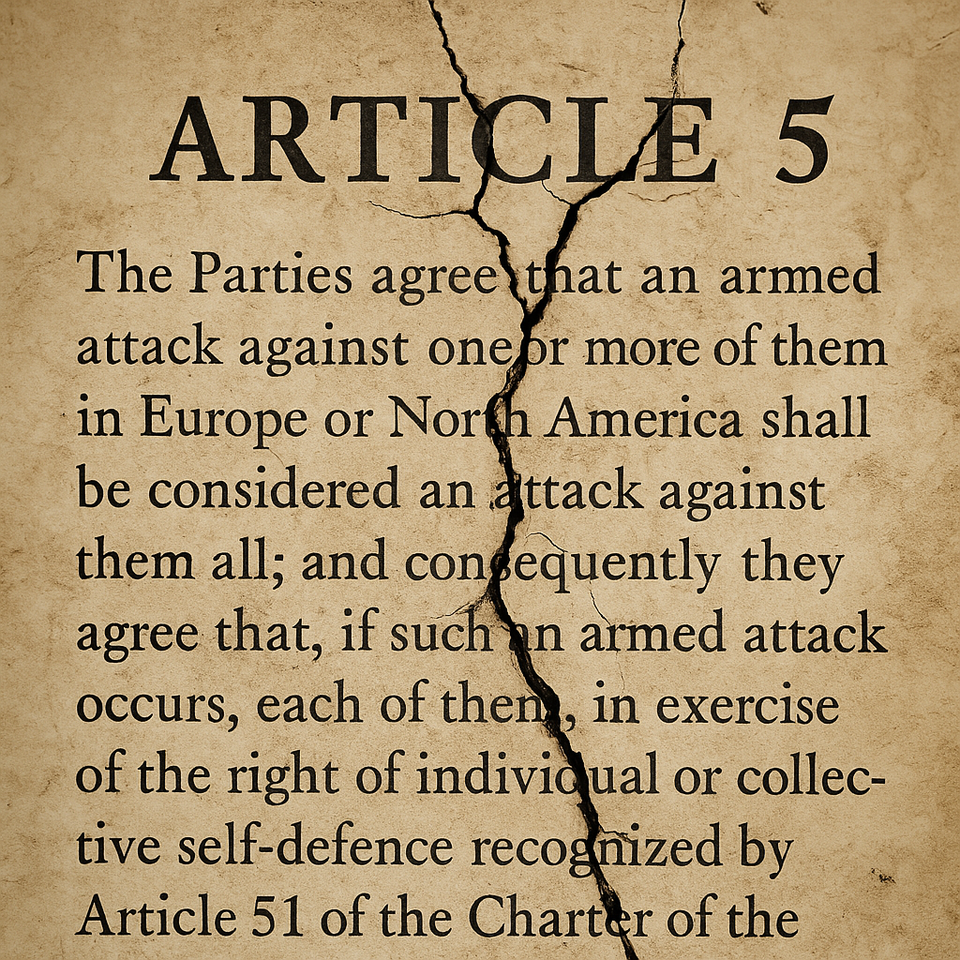
This is a crucial point. The 1949 North Atlantic Treaty binds its members together in a collective defense agreement. If any member state is attacked, the others are obligated to respond. Article 5 of the treaty is clear:
“An armed attack against one or more of them… shall be considered an attack against them all.”
Though rarely invoked—only once, in response to the 9/11 attacks—Article 5 is the backbone of NATO’s deterrence. It is designed to prevent aggression by guaranteeing collective defense. It is not a flexible suggestion. It is the foundation of post-WWII peace in Europe.
So when Donald Trump—first in 2019, and now again in 2025—floats the idea of “taking” Greenland, either through purchase or force, he is not joking. He is proposing a direct challenge to Danish sovereignty. And because Greenland is part of a NATO member state, this challenge is not simply diplomatic—it is existential.
Strategically, Greenland holds immense value:
• It is home to Thule Air Base, a critical U.S. military installation within the Arctic Circle.
• It sits at the center of newly navigable Arctic trade routes, created by melting ice caps.
• It holds rare earth minerals, critical for 21st-century technology.
These facts are not lost on global powers. China has long sought greater access to Greenland’s resources, and Russia has stepped up Arctic militarization. But only Trump has repeatedly suggested the United States should take it.
And now Putin has made it clear why.
II. What NATO Article 5 Actually Means
At the heart of NATO’s existence lies a single, powerful commitment: Article 5 of the North Atlantic Treaty. Drafted in 1949 after the devastation of World War II, Article 5 was designed to deter aggression by creating a unified response to any attack on a member nation.
The exact wording reads:
“The Parties agree that an armed attack against one or more of them in Europe or North America shall be considered an attack against them all…”
This is not just symbolic. It is a legally binding obligation that has held the alliance together for 75 years, preventing wars through mutual deterrence. NATO’s strength comes from this clarity: no one attacks a member without risking war with all.
Only once in history has Article 5 been invoked—by the United States after the September 11th attacks. And the alliance responded. NATO aircraft patrolled U.S. skies. Allied forces joined Americans in Afghanistan. It was proof that the clause was more than words—it was action.
But here is what most people don’t realize:
NATO has never had to face a situation in which one of its own members becomes the aggressor.
The treaty does not grant immunity to members who initiate attacks. There is no clause that allows one NATO country to invade another. In fact, such an act would trigger a full-scale crisis of legitimacy—and likely, an emergency convening of NATO’s political leadership to determine how to respond.
Legal scholars and defense analysts have addressed this theoretical scenario for decades, especially in the context of nuclear weapons or rogue states. Their conclusion is chillingly consistent:
If one NATO member attacks another, Article 5 still applies—and the rest of the alliance must decide whether to respond in defense of the victim nation.
If Donald Trump were to use U.S. military or coercive power to seize Greenland from Denmark, that would constitute an act of aggression against a NATO ally. Period.
Even short of a full military invasion, the use of intimidation, blockade, or unilateral annexation would violate international law and place Denmark in a position where it could rightfully invoke Article 5.
NATO would then face a horrific dilemma:
• Respond to Denmark’s call, preserving the alliance but potentially entering into open conflict with the United States.
• Or refuse to act, shattering the credibility of Article 5 and ending the NATO alliance in all but name.
This is not just a diplomatic issue. It is a foundational crisis for the Western world. And Putin knows it.
By provoking such a scenario—using Trump as the lever—Russia can achieve what decades of Cold War strategy could not: the internal collapse of NATO from within.
III. The Logic of the Threat
There is a reason Vladimir Putin is suddenly encouraging the world to take Donald Trump’s threats seriously—especially his revived interest in seizing Greenland.
At first glance, it might seem absurd: why would Russia support a plan that involves U.S. expansion? But viewed through the lens of global strategy, it becomes clear. Putin’s goal is not to help Trump succeed. His goal is to watch NATO fail.
A Masterstroke of Internal Sabotage
For decades, Russia has sought to weaken the NATO alliance. It has done so through disinformation campaigns, cyberattacks, proxy wars, and diplomatic manipulation. But its greatest opportunity lies in something far simpler: getting a NATO member to destroy the alliance from within.
Trump provides that opening.
If Trump attempts to seize Greenland from Denmark—whether militarily or through coercion—he forces NATO into an impossible situation:
• Defend Denmark, and the alliance must confront the United States directly.
• Do nothing, and NATO’s credibility is destroyed forever.
This scenario places Europe in a no-win position. And that is precisely what Putin wants.
It’s not about Greenland. It’s about discrediting NATO’s core promise—that an attack on one is an attack on all.
By exploiting Trump’s ambition and disregard for international norms, Putin is manufacturing a situation in which NATO appears either powerless or fractured. And the moment Article 5 is weakened, the consequences echo worldwide.
IV. Why This Is Not Partisan
There is a dangerous misconception circulating today: that concerns about Trump’s actions are rooted in political bias rather than objective analysis. But when it comes to the NATO alliance, international law, and the global security architecture that has preserved peace for over 75 years, there is no partisan lens.
The crisis emerging around Greenland is not about ideology. It is about sovereignty, legality, and the fragile balance of peace.
This Is About the Rule of Law
Trump’s rhetoric around “taking” Greenland violates the basic principles of international law—specifically the UN Charter, which prohibits the use of force against the territorial integrity of any state. The idea that a powerful country can seize part of another sovereign nation—especially a fellow NATO member—is precisely what the post-WWII order was created to prevent.
There is no legal mechanism for the United States to “purchase” Greenland without Denmark’s full consent. And there is certainly no justification for unilateral action. If Trump were to pursue any form of coercive acquisition, it would place the U.S. in violation of:
• The North Atlantic Treaty (Article 1: peaceful resolution of disputes)
• The UN Charter (Article 2: prohibition on the threat or use of force)
• The Hague and Geneva Conventions, which govern wartime conduct and respect for sovereign territory
This is not about red or blue. It is about right and wrong under international law.
Military Experts, Not Just Political Opponents, Are Sounding the Alarm
Former military leaders and diplomats—across administrations—have consistently warned that undermining alliances like NATO is a gift to authoritarian adversaries. Trump’s actions in the past, from withholding NATO contributions to threatening withdrawal, have already weakened the alliance.
But a direct provocation against Denmark would be unprecedented—and many nonpartisan analysts see it as a tipping point.
“The NATO alliance is based on mutual trust. If the U.S. were to act against another member, it wouldn’t just be a legal breach—it would be a moral one. It would destroy the foundation of everything we’ve built since 1945.”
— General Wesley Clark, former NATO Supreme Allied Commander (paraphrased)
This is about far more than Greenland. It’s about whether the rules-based international order survives the 21st century—or whether power and aggression replace diplomacy and law.
If the U.S. can violate treaties, disregard allies, and act as a rogue state without consequence, then China, Russia, and every other authoritarian regime will follow suit. What starts with Greenland may not end until global stability is shattered.
Conclusion: The Fuse Has Been Lit
This is not a quiet shift. It’s a loud declaration.
Putin is saying the quiet part out loud.
He has broken his usual silence on Trump to signal what comes next:
A crisis that will either fracture NATO from within or provoke a war that ends it altogether. This is not a misinterpretation. It is their strategy, spoken plainly, because they now believe no one will stop them.
That’s why this moment matters.
Not because of what’s being whispered in back rooms—but because of what’s being said out loud, on purpose.
We are being told exactly what’s coming.
It is our responsibility to listen.
We may not be able to prevent Trump from acting. But we can refuse to be complicit through silence. We can speak, publish, translate, and organize. We can remind the world that NATO was never a given. It was built, painstakingly, to keep peace.
Because once the world stops believing in Article 5, there is no deterrent left.
And the collapse won’t begin with tanks or missiles.
It will begin with doubt.
Let us be precise, factual, and loud—before that doubt becomes reality.