
If You Can’t Read This, the Censorship is Working
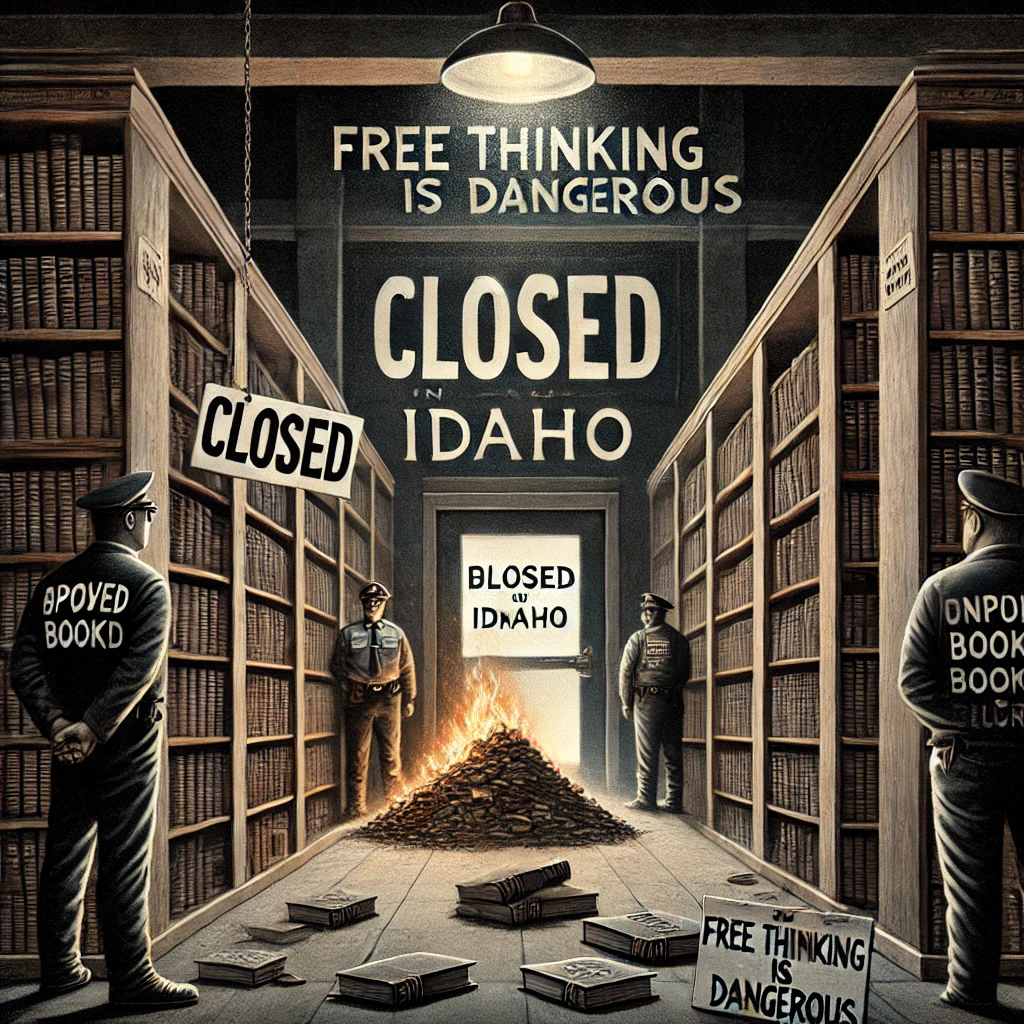
Welcome to the Library: No Books Allowed
How Idaho’s Book Bans Are Erasing the Future—And Why That’s the Point
Shhh… The Library is Closed (Indefinitely)
At last, a bold new approach to child safety—removing the threat of books entirely. For too long, libraries have endangered children with reckless exposure to knowledge, curiosity, and thought.
But Idaho has finally taken a stand. Why merely ban books when you can ban access to books altogether? Why risk letting a child’s curiosity take them somewhere unauthorized when you can close the doors before they even get inside?
This isn’t just about restricting certain books. It’s about shutting down learning before it even begins.
The Real Target: Independent Thought
The justification for these bans is always the same. “Protecting children.” But let’s be clear—this is not about keeping kids safe. It’s about controlling what they know.
Throughout history, the most effective way to suppress people isn’t to outlaw their thoughts—it’s to make sure they never learn how to think freely in the first place.
• The U.S. Slave Codes: Criminalizing Literacy to Maintain Power
• In the 19th century, teaching enslaved people to read was a crime. Slaveholders understood something fundamental: literacy meant autonomy.
• If you could read, you could question. If you could question, you could resist.
• Keeping people illiterate ensured they would never develop the tools to challenge their oppression.
• Nazi Germany: Book Burnings and the War on Knowledge
• The Nazis didn’t just ban books; they burned them.
• Jewish authors, political dissidents, even science that contradicted Nazi ideology—if a book contained a dangerous idea, it went up in flames.
• The goal? Eliminate access to alternative perspectives, ensuring that only state-approved propaganda remained.
• The Taliban: Banning Education to Control the Population
• When the Taliban took over Afghanistan, one of their first acts was banning girls from school.
• Why? Because education gives people power—the power to question, to demand rights, to imagine a different future.
• A girl who learns to read becomes a woman who challenges authority.
And now, here we are, in the United States in 2025, watching the same tactics play out. Why? Because they work.
• When you take away books, you take away curiosity.
• When you take away curiosity, you take away critical thinking.
• When you take away critical thinking, you take away the ability to challenge power.
This isn’t just about libraries. It’s about who gets to decide what people know—and what they don’t.
The “Approved” Library of the Future
Let’s imagine the Idaho library of tomorrow:
• Shelves emptied of dangerous ideas. No banned books, sure—but also no books at all, because even choosing a book is a risk.
• Security at the doors. Who knows what kids might try to smuggle in?
• A carefully curated selection of state-approved literature. The Bible (certain versions only), a stack of NRA pamphlets, and a lone, well-thumbed copy of Atlas Shrugged.
• Librarians retrained as compliance officers, ensuring that no child is exposed to forbidden knowledge.
And what happens when a generation of children grows up without access to ideas?
The Far-Reaching Consequences: A Nation Without Learners
This isn’t just about stopping kids from reading certain books. It’s about stopping them from reading, period.
• Curiosity isn’t just about books—it’s the foundation of lifelong learning.
• A child who never learns to seek out information on their own grows into an adult who only consumes what they are given.
• Without curiosity, learning stops. And without learning, people become easier to control.
• The death of curiosity means the death of self-driven learning.
• No books means no exploration, no new ideas, no unexpected discoveries.
• A society that doesn’t teach its children to ask questions raises adults who never challenge authority.
• The consequences go beyond education—they shape the future.
• Historically, controlling knowledge has always been a tool of oppression.
• The fewer independent thinkers a society produces, the easier it is to keep people compliant, obedient, and uninformed.
And that’s exactly the point.
Read Like a Rebel
Knowledge has always been dangerous to those who seek control. If books are banned, then reading them becomes an act of defiance.
• Every banned book must be read twice.
• Every child must be given access to the ideas that those in power fear most.
• If we let them take away books, we let them take away futures.
This isn’t just another culture war. This is a deliberate, systemic attempt to control what the next generation knows, thinks, and believes.
And if we don’t fight back, history tells us exactly where this road leads.
Call to Action
• Support libraries, independent bookstores, and banned book programs.
• Donate banned books to schools and community groups.
• Read the books they don’t want you to read—and make sure the next generation can, too.
Because when access to knowledge disappears, so does freedom.
Endnote: A Living History of Suppression
This essay will be archived and made available in multiple formats to ensure that no matter what happens to libraries, bookstores, or online platforms, it remains accessible. If you’re reading this in a time when it’s no longer safe to publish these words freely, know this:
History has been here before. And history tells us exactly what happens next—unless we stop it.